Budget 2026: what John Healey's first Budget means for your payslip
A month ago none of this was supposed to happen. Rachel Reeves had set out her stall through to 2031, the tax rises were legislated, and the Treasury was looking forward to a quiet autumn. Then July happened. Keir Starmer out, Andy Burnham in, Reeves gone from government entirely, and John Healey moved from Defence to the Treasury. Eleven days into the job he announced his first Budget, by Instagram video of all things. It lands on Wednesday 28 October.
We build a take-home pay calculator for a living, which means we spend Budget season doing the one thing most commentators can't be bothered with: working out what actually changes on a payslip, to the pound. So here's our honest read on what Healey is likely to do on 28 October, and what he can't. Some of it is informed guesswork. We've said so where it is, and we've put rough odds on the calls so you can hold us to them in November.
The corner he's boxed into
Start with the arithmetic, because everything else follows from it.
Burnham kept the manifesto pledge: no increase in the basic, higher or additional rates of income tax, no rise in employee National Insurance, no rise in the main rate of VAT. That rules out the three levers that raise serious money quickly.
Against that, the bills have been arriving. The government has already committed to taking VAT off domestic electricity (about £1.7bn a year), a rough sleeping programme, the junior doctors' settlement, and roughly £9bn of extra defence spending that Healey himself championed in his last job. City AM totted the unfunded pledges up at around £22bn, which is more or less the entire £21.7bn of headroom Reeves left behind. The Institute for Fiscal Studies thinks the true gap is £25bn or more. NIESR's latest estimate of the room actually left is £3.4bn, and higher debt interest since the Iran war has eaten into even that. Inflation, which the Bank expects to peak at 3.8% early next year, quietly erodes the spending plans by another £24bn in real terms by the end of the decade.
So: a Chancellor who has promised fiscal discipline, a Prime Minister with expensive instincts, no big lever he's allowed to pull.
Every prediction below flows from that squeeze.
The tax rises already in the post
Here's the part most coverage misses. A lot of your tax future was legislated last November and needs nothing from Healey at all.
The freeze on the personal allowance and the higher-rate threshold now runs to April 2031. The official costings say the extension alone raises £3.4bn in 2028/29, £7.8bn the year after, and £12.4bn the year after that. That money comes from pay rises dragging people across thresholds that no longer move.
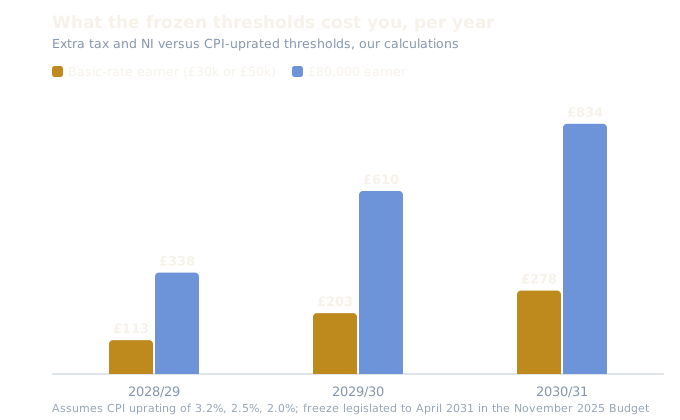
We ran the numbers through our own tax engine. If thresholds instead rose with inflation from April 2028, on the Bank of England's current inflation path, a £30,000 earner will pay about £113 more in 2028/29 than they would under uprating, rising to £278 more by 2030/31. On £80,000 it's £338 rising to £834. Over the three extended years that's roughly £594 for a basic-rate earner and £1,782 on £80,000.
Nobody will announce any of this on Budget day. It's already law.
Also in the pipeline, and likewise needing no announcement: dividend tax went up two points this April. Tax on property and savings income goes up two points next April. The £2,000 cap on salary-sacrifice pension contributions escaping National Insurance arrives in April 2029. The council tax surcharge on £2m-plus homes starts in April 2028. And fuel duty is mid-way through a staged 5p restoration, 1p of which came back this September, with 2p due in December and 2p more in March.
What we think Healey will actually do
The threshold freeze stays. (9 in 10.) Burnham called the frozen personal allowance “the number one issue” before he got the job, then went quiet on it afterwards. We understand why. Restoring the personal allowance to where inflation would have taken it since 2021 costs £8.5bn to £9bn a year, which is money he does not have. Expect warm words about reviewing it “when conditions allow”.
Property is the centrepiece. (7 in 10 for a formal consultation.) This is the Burnham signature. He has called council tax “highly regressive”, pointed out that English bands still rest on 1991 valuations, and has a long association with the Fairer Share campaign for a proportional property tax (0.48% of value a year for owner-occupiers, in that blueprint). Our bet is a green paper on replacing or revaluing council tax, possibly with the £2m surcharge extended down the price scale as a bridge. A new annual property tax starting this Budget? No. That's a manifesto-sized fight, and this government's majority dates from 2024, not from any mandate of Burnham's own.
Capital gains gets tightened, not aligned. (Evens.) Full alignment with income tax rates makes the spreadsheets sing and the investment lobby scream. The last two Budgets went for rate nudges and relief trims instead, and we'd back more of the same over the big bang.
The December fuel duty rise gets deferred. (Slightly better than evens.) With inflation peaking early next year, letting a visible pump price rise land in December looks politically careless, and deferral only costs about £900m a year. This is the classic pre-Christmas rabbit.
The salary sacrifice cap comes forward. (1 in 3.) The £2,000 cap is legislated for 2029 and scored at £4.7bn in its first full year. Pulling it forward to 2028 is the kind of quiet, already-announced-so-not-really-a-new-tax move Treasuries love.
A social care levy gets floated, not launched. (2 in 5 for a consultation.) Burnham has argued for a National Care Service for fifteen years, and a 1.8% levy idea is circulating in policy circles. But a new levy on earnings looks and smells like the NI rise he's promised not to do. A commission or consultation, then, with any actual levy parked safely beyond the next election. An announced levy with a start date: 1 in 5.
Banks and gambling pay for the optics. (3 in 5 that at least one gets hit.) Every constrained Chancellor reaches for a sector that can't vote. The bank surcharge and gambling duties are the obvious candidates, particularly with defence spending to dress up.
The pension tax-free lump sum survives again. (3 in 4.) It gets briefed against every year and it terrifies people every year, and it keeps surviving, because cutting it enrages exactly the voters who turn out. The salary sacrifice cap was last year's pensions raid; we doubt they go back so soon.
Put together: a package somewhere in the £15bn to £25bn range, tilted heavily towards wealth and property and reliefs, with the words “working people” doing a great deal of load-bearing.
What this does to your take-home pay
Probably nothing on Budget night itself, and that's the strange part. The rates on your payslip are politically locked, so the consolidation happens everywhere except the place you'd look for it. Your income tax and NI on the October payslip should be identical in November. The freeze does its work invisibly, in the pay rise that quietly gets taxed harder than the last one.
The thing to watch on the day is anything touching pensions and salary sacrifice. That's where a determined Chancellor can reach your net pay without going near a headline rate.
Whatever happens on 28 October, you can check your own numbers the same afternoon. The calculator on this site and our free iPhone app both update their rates remotely whenever a Budget changes something, no app update needed. Put your salary in and you'll see exactly what Healey did to it, band by band.
Written by the Salary Calculator UK team. The threshold freeze figures are our own, assuming CPI uprating at 3.2%, 2.5% and 2.0% across the three extended years, in line with the Bank of England's published path. Official costings come from the November 2025 Budget documents.